Those never-admitted European ransom payments

The Anglophone media has recently been making

noises about European governments making ransom payments to kidnappers.

It’s interesting that this has taken on the status of accepted fact — while, as far as I can tell, no European government has officially confirmed it. On the one hand I’m pleased that the media has the courage to report government actions without a press release. On the other, I’m a little nervous about how much this seems down to co-ordinated briefing by American officials. True it may be, but it’s apparently a truth only reported when it suits the powerful.

At the very least I’d hope that European journalists would browbeat officials into either confirming or denying the American (and British) official claims of ransom payments.

ETA: This New York Times article on the topic is pretty impressive, though, and obviously based on a lot of research.

KRG oil in Texas

The slow progress of oil tankers makes for a nice change from the jackhammer pace of news. Disputes about Kurdish oil exports have been pottering along for months, following the movement of a few tankers around the world.

So we have the SCF Altai, which has apparently been running oil between Ceyhan and Israel since June.

And across the Atlantic there’s the United Kalavrta, which has been loitering off Texas while Iraq and Kurdistan slug out ownership rights in court. Once the court ruled against Iraq, the tanker promptly turned off its tracking beacon, and is now presumably unloading as quietly as possible.

ISIS’s new German-made missiles

Germany has, after much soul-searching, decided to supply weapons to Kurds fighting against ISIS.

It must be slightly awkward, then, to discover that ISIS already have German weapons


hot_isis

Eliot Higgins identifies these as  HOT anti-tank missiles, made by a Franco-German consortium called Euromissile. 1000 of them were sold to Syria in the late 70s — officially by France, though Germany was deeply involved in the manufacture, and would have been consulted about the sale.

Embarrassingly, these HOT missiles are close cousins of the MILAN missiles, which Germany will now be giving to the Kurds. So Germany, usually one of the better-behaved arms exporters, gets the cachet of arming both sides with more-or-less the same weapons. Oops.

In fact, selling these to Syria was controversial  at the time in Germany. Not only did it break Germany’s rules on not arming “areas of conflict” — but since the conflict in question was between Syria and Israel, it caused strong protests from Israel. The German excuse was that, despite their German components, these were a French responsibility:

Government sources said missile exports to France were legal, provided the necessary government export permit was obtained, but once the items were in France, there was no ban on the re-export of the items to third countries.

This fit into an ongoing pattern by which Germany used France as the scapegoat for its weapons sales:

In a government agreementconcluded in 1972 Bonn and Paris agreed to interpretand apply their countries’ weapons export law “in the spirit of German-French cooperation.”

A little after this sale, Germany went even further in sidestepping responsibility:

Under SPD [Social Democratic Party of Germany] Chancellor Helmut Schmidt the Federal Government stipulated in 1982 that German parts for “Roland,” “Hot,” and”Milan” that were incorporated in the weapon in France “will be treated as goods of French origin.” They simply turned into French parts that are not subject to German export control. Thus, German consciousness remained unburdened.

[based partly on research by Charles Lister and Brown Moses]

Market Basket

Jacobin on industrial action at supermarket chain Market Basket, as workers demand the reinstatement of a CEO who treated them well:

25,000 store employees are still showing up for work, while at the same time asking customers to boycott Market Basket. They are demanding the reinstatement of their recently fired CEO, Arthur T. Demoulas, deposed by his cousin, Arthur S. Demoulas. Arthur T. is an atypically benevolent corporate head.

Market Basket workers are doing what is generally unthinkable in the precarious service economy: exerting their power as workers and risking their paychecks for their pride, good benefits and pay, and vision of how their workplace should operate — without the encouragement or protection of a union.

So Kanno

Last night I was blown away by the work of So Kanno, a Japanese electronic artist based in Berlin. He was presenting at the Creative Coding Stammtisch, a digital artist meetup which — judging by my one and only visit — has an exceedingly high level of knowledge.

One of his neat ideas is the graffiti robot. Exploiting the chaotic motion of a double pendulum, this spray-paints quasi-random tags onto a wall. It’s not just fun to watch robot vandalism, but the results come out looking uncannily similar to plenty of human graffiti.

He also showed some very, very cool work with automatic 3D modelling, clothing manufacture and celebrity photos — but since he seems not to have written about it yet, I’d better keep schtum.

Trust in the UK

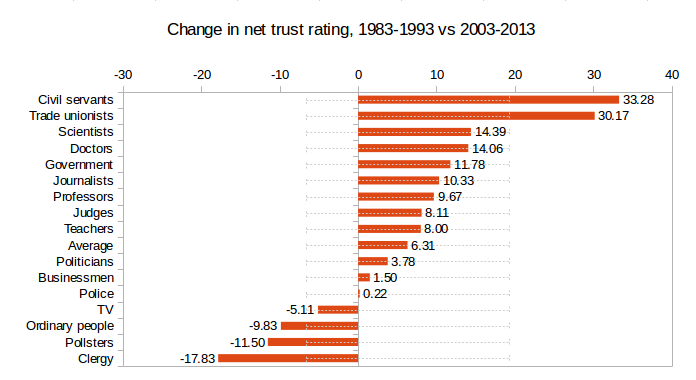
Alex at TYR discovers that we have become more trusting since the ’80s.

He’s taken a bunch of polls on which professions are trusted, and compared those for ’83-93 against those for ’03-’13. Trade Unionists are now much more trusted, presumably becuase they have been entirely defanged. Likewise civil servants, although they’re still trucking along more-or-less as they were.

Overall, though, it seems we now have a lot more faith in our institutions. So much for the idea that the center is falling apart, and society is fragmenting into mutually-suspicious subcultures.

Crooks and thieves, LDPR carding edition

An alleged Russian credit-card hacker has been extradited to the US after being arrested in the Maldives, says Kenneth Rijock. To complicate matters, his dad is a Duma deputy, and a member of the far-right Liberal Democratic Party)

Looking at the indictment, what surprises me is how manual the entire carding operation is.

Could tax inversion work for tech companies?

‘Tax inversion’ mergers are an increasingly-popular way for multinationals to dodge their tax bills, by arranging to be taken over by a corporation in a lower-tax jurisdiction. Fruit of the Loom, for example, used this dodge to move to the Cayman Islands back in 1998.

In the current wave, a string of companies are queuing up to move to Ireland through tax inversions, with pharmaceutical companies being the largest among them. Here the FT looks at a current example, Abbvie (US) planning to merge with Shire (UK/Ireland)

Reading the FT’s commentary makes it painfully clear that there is little business logic to a deal like this, beyond the massive extra profits to be had from dodging tax. And despite the political unpopularity, the IRS hasn’t yet found a way to crack down on them.

All this makes me look at the tech sector in a new light. Companies like Google, Apple and Microsoft are hoarding huge piles of cash in their non-US subsidiaries. They’ll be liable for a massive tax bill once they bring it back to the US — which they will need in order to pay it out as shareholder dividends.

The general assumption is that they are waiting for some kind of tax break — if not a permanent change in the law, at least a one-off amnesty which will let them bring the money home. I’m now wondering, though, whether some of them are also contemplating a tax inversion. Move out of the US, then finally claim your profits and pay out dividends at a lower tax rate. This analysis suggests it’s likely, but has found no tech companies even hinting that they are contemplating it.

Searching overseas servers

Did you ever worry which jurisdiction a server was in? No longer. The US and UK have both decided they can demand access to data regardless of where in the world it is, writes Marcy Wheeler.

The UK version comes courtesy of DRIP, the surveillance bill being rushed through parliament to avoid awkward questions. The government’s defense, bizarrely, is that they have been doing this all along:

The home secretary told the Commons home affairs committee that it had always been assumed “in government circles” that the requirement on overseas companies to comply with British intercept warrants was included in the 2000 Regulation of Investigatory Powers Act.

In the US, the government has won a case forcing Microsoft to turn over data from Ireland:

the U.S. feels free to demand data from U.S. companies no matter where that data is stored. So while Microsoft’s challenge largely serves to make its legal obligations visible to the rest of the world, the legal case may have real consequences, both legally and economically.

So, in brief: wherever in the world your data is, it isn’t safe from hte UK or the US

770 migrants died this year, trying to reach the EU

So far this year, 770 migrants have died trying to reach Europe, or trying to stay here.

That’s an underestimate.

The Migrants Files contains the details. It’s an attempt to track all the deaths associated with migration in(to) Europe. The details make for sobering reading:

  • 25 migrants were locked up in a cold store by their traffickers in Libya. 13 died.
  • The 27 survivors of a shipwreck said there were an additional 75 persons on board.
  • A migrant was shot at Calais. No other details were provided by the police.
  • Stowaway fell from the wheelbay on a plane to Zürich.

It goes on, and on — 2780 incidents stretching back to 2000. 25,000 dead.

And, aside from the occasional media fuss, we don’t care. We don’t even know the names of most of the victims, let alone the circumstances which drove them to risk their lives in transit. The deaths aren’t being tracked officially — this is a database put together by journalists, mianly from news reports.