A boy named Śunaḥśepa

“He had three sons, called Dogpenis, Dogpenis and Dogpenis”

Sanskrit translation class. My lecturer had a good deadpan, and the flatness of his voice told me he’d been looking forward to reading this line for a while.

He accepted that his translation might not be 100% clear-cut — maybe one or two of them might be called dog tail, not dog penis? But surely dogpenis makes more sense than dogtail as the name of your firstborn? Right? Right?

Um. His argument was that humiliating names are lucky. If some bad spirit meets you, it’ll decide that you’ve suffered enough and not do anything worse to you. If I were Dogpenis, i’d find that pretty unconvincing. But it does seem to be a thing people do, in India and elsewhere, for exactly that reason. And it’s not like ‘Dogtail’ is a name you’d want to go through life with either.

Then again, the source is a story about how the father sells one of his sons as a human sacrifice. So possibly giving his sons degrading names wasn’t a cunning strategy to protect them from cruel fate. Maybe dad was just an asshole.

( The passage is Aitareya Brahmana 7.15. The 3 names are Śunaḥpuccha, Śunaḥśepa, and Śunolāṅgūla. Śunaḥśepa is the only one of importance in the story, and also the one whose name looks most like dog-penis. And yes, I did just spend far too long tracking this down)
Morning Star of Lingao

Morning Star of Lingao is a huge Chinese web novel, collectively written on forums by 500+ authors. The plot is about a small group reconstructing industrial civilisation from the ground up, with an obsessive focus on the technical details. According to a Wired article:

The writing of it became a phenomenon across Chinese internet forums in the 2010s: Its open source ethos and collaborative methods deeply appealed to China’s burgeoning tech community. Beyond regular meetups among core contributors, Lingao’s creation fostered the formation of China’s “keyboard politics”—online communities where users engage in fierce debates about governance, policy, and national direction under the protection of pseudonyms. These conversations became staging grounds for political arguments that couldn’t happen elsewhere, where amateur policy wonks, military enthusiasts, and armchair strategists honed their worldviews.

It’s several million words, plus an archipelago of fanfic. It’s apparently often excellent on the mechanics of how to build industrial processes, somewhat less polished in literary terms. So for now I think I’ll be just admiring it from a distance.

Surnames are not insults

Isn’t it curious how few last names are insults?

The usual story: surnames came about when bureaucrats needed to identify people who they didn’t know personally.

In a village of 60 people, a single name is enough to tell who’s who. Everybody knows everybody. So even when people share a first name, it’s easy to tell them apart. Is it John the Miller? Or John from Harby? Or John, Peter’s son? Or little John?

It’s just the tax collector who doesn’t know who you’re talking about, and who needs an unambiguous name to write in his ledger. Or perhaps it’s the priest recording a marriage or a death. So John becomes John Miller, or John Harby, or John Peterson, or John Little.

And those are, roughly, the categories of surname which emerge in medieval Europe. Names come from professions, or jobs, or patronymics. Or from that last category (John Little), names based on some physical or personal characteristic of the person. Nicknames, basically.

The thing is that most of the nicknames are positive, or at least neutral. Wise is a common surname; Stupid is not. Strong is common, Weak is not.

If this doesn’t surprise you, you probably weren’t bullied in school.

Or, if you want a less immediate demonstration of the tendency towards cruelty in names, look at Norse “by-names”. These are another forerunner of surnames, but directed towards sagas and story-telling rather than to the tax collector.

And…they are brutal — but brutal in a style pretty close to what you’d expect to find in a modern school. Examples include “foul-fart” and “butter penis”, alongside less startling insults like “foolish” or “bald”. There were laws against derogatory nicknames, usually a reliable sign that something is happening frequently enough to annoy people.

I suppose it’s not hard to imagine villagers toning down their choice of names for the bureaucrats and the priests. Even if Eystein was willing to embrace his nickname “Foul-Fart”, he might have hesitated to tell it to the priest. Or the priest might have hesitated to write it down, and encouraged him to choose again. Or even if it survived into the first generation, perhaps his son managed to get himself re-named.

Expert Consensus

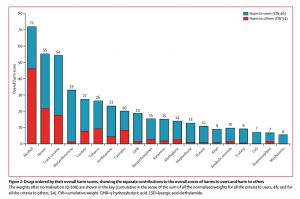
David Nutt is a British public health expert who made his name by arguing that alcohol is pretty harmful even in comparison to heroin, cocaine or other illegal drugs.
In 2009 he was sacked as a government advisor, more-or-less because he wasn’t willing to rubber-stamp their drug policy. Then he made headlines again in 2010, with a paper that ranked all the drugs and found alcohol to be the worst of the worst.


I’d read the newspapers and nodded along. Respected scientists gather the evidence and find that some legal drugs are worse than illegal ones — fine, I can believe that.

But then I took a look at the underlying study. It is…not good.

The methodology isn’t quite “I asked my mates, and they agreed with me”, but it’s not not that either.

Nutt, after being sacked, went off and set up his own think tank. He called it the “Independent Scientific Committee on Drugs” — though its impartiality wasn’t obvious to everyone. He told the media that he planned to “put together an assessment of drug harms which will challenge some of the aberrations [of UK government drug policy]”.

The Lancet paper is that assessment. The methodology was to assemble the members of the new committee (plus 2 outsiders), and ask them to rank how harmful they thought the drugs were, according to different categories.

So it wasn’t entirely freeform, there was some kind of structure to assemble a consensus view and weight different elements.

But when you come down to it, it’s just aggregating the views of a group of people who likely wouldn’t be in the room if they didn’t share a particular perspective on drugs.

Snippets 19.4

What I’ve been reading lately:

when the concentration camps were liberated by the Aallies they did not set free all the prisoners with pink triangles. Those with convictions in the Nazi courts for so much as flirting with another man were required to serve out their sentences, with no credit for time served. — Guardian review of The Fifties: An Underground History by James R Gaines

There is a long tradition of doing research where we say, “What predicts voting out the incumbent? The national unemployment rate, or whether you personally are unemployed?” And it really is the national unemployment rate that is predictive. — Bryan Caplan]

The preeminent characteristic of human beings is that we imitate each other (thus the term “Mimetic Theory”). This mimesis is not mere mimicry, but an instinctive and preconscious impulse. Even our desires—especially our desires—come from the imitation of others. Because we want the same things that others want, we come into conflict over who will possess the desired object. — How to Read Girard