Linton Kwesi Johnson, Sonny’s Lettah

Sometimes a poem finds you unexpectedly, and is all the more moving for that reason. Sonny’s Lettah, by Linton Kwesi Johnson, is one of those.

Last year a friend found a book of English poetry on the street in Berlin, and asked me for help with the language. So I started reading aloud to her the first poem in there, which was Sonny’s Lettah:

It was de miggle a di rush hour
Hevrybody jus a hustle and a bustle
To go home fi dem evenin shower
Mi an Jim stan up waitin pon a bus
Not causin no fuss

Yep, I can understand why a non-native speaker found that hard going. But read it aloud, and it all starts to come together. Still, we didn’t really know where we were headed, until we found ourselves in the middle of a police beating:

Dem thump him him in him belly and it turn to jelly
Dem lick ‘I’m pon ‘I’m back and ‘I’m rib get pop
Dem thump him pon him head but it tough like lead
Dem kick ‘I’m in ‘I’m seed and it started to bleed

Definitely doubly powerful because we had no idea where we are gong. I had only vaguely heard the name Linton Kwesi Johnson, and knew nothing about the sus (stop and search) laws which this poem was part of the movement to abolish.

I say poem, but this is very definitely performance poetry. Had I just read it on the page, I doubt it would have got under my skin in the way it did. Short of reciting it yourself, the best way to experience it is surely Linton Kwesi Johnson reading it over a bass line:
Cryptic Crosswords on Youtube

The cryptic crossword has a special place in my heart, alongside cricket, as a British obsession which it is near impossible to describe to foreigners*. Start trying to explain either, and they will (quite reasonably) conclude that you are pulling their leg.

How can you explain something like this?

! (1,6,1,4)

I haven’t a clue.

Being fairly incompetent at solving crosswords, I’m happy watching youtube videos where somebody else works their way through a crossword. While there are less of these than I might have expected, those I do find are a nice combination of soothing and stimulating:

And yes, when I showed this to my (non-British) boyfriend, he only half-believed that I was not making it up.

(*) Non-commonwealth followers, I should probably say. From India to Australia: where there is cricket there are also crosswords

Cryptic Crosswords on Youtube

The cryptic crossword has a special place in my heart, alongside cricket, as a British obsession which it is near impossible to describe to foreigners*. Start trying to explain either, and they will (quite reasonably) conclude that you are pulling their leg.

How can you explain something like this?

! (1,6,1,4)

I haven’t a clue.

Being fairly incompetent at solving crosswords, I’m happy watching youtube videos where somebody else works their way through a crossword. While there are less of these than I might have expected, those I do find are a nice combination of soothing and stimulating:

And yes, when I showed this to my (non-British) boyfriend, he only half-believed that I was not making it up.

(*) Non-commonwealth followers, I should probably say. From India to Australia: where there is cricket there are also crosswords

Links

Redfern Jon Barrett on the parallels between queerness and disability:

Firstly, each has the ability to make the public uncomfortable, as each causes us to question our own identities: whether the shaky and often-transitional nature of our perceived gender, or our immortal able-bodiedness. Each presents us with a deviation from the norm which a great number of people still feel uncomfortable with, and which presents this difficult truth: that the privilege one receives for cis-heterosexuality or able-bodiedness is a result of random chaotic chance.

The grammar of hyperlinks – and a grammatical spin on how they are used to support an argument:

In other languages there are features of the grammar that mark the source of information. When source of information is part of the grammar, this is known as evidentiality. I wrote my PhD thesis about evidentiality in Lamjung Yolmo. In this language, and many Tibetan languages, there are different forms of the verb ‘to be’ depending on whether you know the information you’re talking about from your own long-held experience, or because you saw or heard it happen, or because someone told you about it. Evidentiality occurs in around a quarter of the world’s languages.
Hyperlinks act as an evidential that covers a broad range of evidence that can be summed up as “I know this from evidence over at this other location”.

[not-quite-relatedly: Gwern on better citation formats for the web]

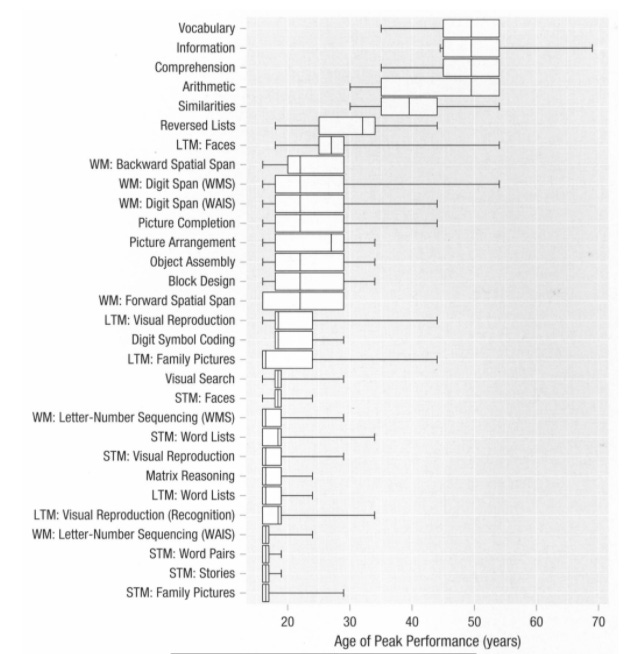
From a too-comforting-to-take-seriously article about development late in life is this graphic:
Ages of peak performance

Links

Redfern Jon Barrett on the parallels between queerness and disability:

Firstly, each has the ability to make the public uncomfortable, as each causes us to question our own identities: whether the shaky and often-transitional nature of our perceived gender, or our immortal able-bodiedness. Each presents us with a deviation from the norm which a great number of people still feel uncomfortable with, and which presents this difficult truth: that the privilege one receives for cis-heterosexuality or able-bodiedness is a result of random chaotic chance.

The grammar of hyperlinks – and a grammatical spin on how they are used to support an argument:

In other languages there are features of the grammar that mark the source of information. When source of information is part of the grammar, this is known as evidentiality. I wrote my PhD thesis about evidentiality in Lamjung Yolmo. In this language, and many Tibetan languages, there are different forms of the verb ‘to be’ depending on whether you know the information you’re talking about from your own long-held experience, or because you saw or heard it happen, or because someone told you about it. Evidentiality occurs in around a quarter of the world’s languages.
Hyperlinks act as an evidential that covers a broad range of evidence that can be summed up as “I know this from evidence over at this other location”.

[not-quite-relatedly: Gwern on better citation formats for the web]

From a too-comforting-to-take-seriously article about development late in life is this graphic:
Ages of peak performance

inflammatory essays

Jenny Holzer

I was maybe 16 when I encountered Jenny Holzer’s Inflammatory Essays, in the form of a postcard which somehow made its way into my small-town life. And no, I wasn’t appreciating it ironically; I was there for the righteous fury. Different circumstances might have channeled it into a punk band or a political cause, but I got Holzer.

Holzer’s work is oddly underrepresented on the internet. So, potted history: she got going in the late 70s, posting slogans (“truisms”) and rants (“inflammatory essays”) on walls around New York. As she became accepted by the art world, the paste-ups were replaced by immense LED displays, scrolling her text across Times Square, JFK Airport, and the Guggenheim.

Perhaps its that art-world history that stops her utterly meme-worthy work being omnipresent online. Or perhaps she’s just very active with her takedown notices. But one way or another, you have to look pretty hard to encounter her on the internet.

inflammatory essays

Jenny Holzer

I was maybe 16 when I encountered Jenny Holzer’s Inflammatory Essays, in the form of a postcard which somehow made its way into my small-town life. And no, I wasn’t appreciating it ironically; I was there for the righteous fury. Different circumstances might have channeled it into a punk band or a political cause, but I got Holzer.

Holzer’s work is oddly underrepresented on the internet. So, potted history: she got going in the late 70s, posting slogans (“truisms”) and rants (“inflammatory essays”) on walls around New York. As she became accepted by the art world, the paste-ups were replaced by immense LED displays, scrolling her text across Times Square, JFK Airport, and the Guggenheim.

Perhaps its that art-world history that stops her utterly meme-worthy work being omnipresent online. Or perhaps she’s just very active with her takedown notices. But one way or another, you have to look pretty hard to encounter her on the internet.

Domestic Cozy, or choosing your own hellscape

Ribbonfarm has a series of posts by Venkatesh Rao on what he calls ‘domestic cozy’, a generational shift away from image-conscious public life and towards home comforts. This post is from 2019 – the pandemic has just supercharged a trend which already existed.

It finds its best expression in privacy, among friends, rather than in public, among strangers. It prioritizes the needs of the actor rather than the expectations of the spectator. It seeks to predictably control a small, closed environment rather than gamble in a large, open one. It presents a WYSIWYG facade to those granted access rather than performing in a theater of optics…. Minecraft, YouTube, cooking at home, and knitting are domestic cozy.

I recognize this pattern, and I loathe it. I’m actually a bit startled by the strength of my negative reaction, and wondering what it says about me.
Living around pleasant things? Buying things for your own joy, not to show off on instagram? I should like this. And yet I have an almost physical reaction of repulsion.
Rao talks about some of the horrors from which Domestic Cozy is a retreat:

people…rendered homeless amidst urban blight, dodging crazy homeless people and gingerly stepping around feces, fallen scooters, used needles, and condoms, as they navigate around high-rises they cannot afford to live in….

I feel yes! yes! I choose THIS hell for my life!. Turns out, I’m old enough that even my dystopia is unfashionable.

Domestic Cozy, or choosing your own hellscape

Ribbonfarm has a series of posts by Venkatesh Rao on what he calls ‘domestic cozy’, a generational shift away from image-conscious public life and towards home comforts. This post is from 2019 – the pandemic has just supercharged a trend which already existed.

It finds its best expression in privacy, among friends, rather than in public, among strangers. It prioritizes the needs of the actor rather than the expectations of the spectator. It seeks to predictably control a small, closed environment rather than gamble in a large, open one. It presents a WYSIWYG facade to those granted access rather than performing in a theater of optics…. Minecraft, YouTube, cooking at home, and knitting are domestic cozy.

I recognize this pattern, and I loathe it. I’m actually a bit startled by the strength of my negative reaction, and wondering what it says about me.
Living around pleasant things? Buying things for your own joy, not to show off on instagram? I should like this. And yet I have an almost physical reaction of repulsion.
Rao talks about some of the horrors from which Domestic Cozy is a retreat:

people…rendered homeless amidst urban blight, dodging crazy homeless people and gingerly stepping around feces, fallen scooters, used needles, and condoms, as they navigate around high-rises they cannot afford to live in….

I feel yes! yes! I choose THIS hell for my life!. Turns out, I’m old enough that even my dystopia is unfashionable.

Physics Design Fiction

What would happen if physicists thought more like engineers or designers?

That’s part of what Michael Nielsen asks in this mind-bending essay:

Now we understand the fundamentals of how matter works: we have a fantastic theory describing the elementary particles and forces, and we’re getting increasingly good at manipulating matter. And so we’re beginning to ask: what can we build, in principle? Not just in a practical sense, with the tools that happen to be at hand, but in a fundamental sense: what is allowed by the laws of physics?

Nielsen has form to think about this. As one of the pioneers of quantum computing, he spent his early career constructing a new discipline by imagining the possibilities latent in cutting-edge physics.

Now he’s zooming out and trying to grapple with the general case. What is the total space of things that could exist, in conformity with the physical rules of the universe? How can we explore that space, unconstrained by the detail of whether something similar actually exists on earth?

And, on the way there, how can we even think about that question? Physics is stereotypically a discipline of discovery, not of invention. Could it take some invention tips from programming, from design, from engineering, even from mathematics?

Nielsen has a lot more to say here. He’s charging straight for the big, big questions, and scoping out a project worthy of being a life’s work, or ending up institutionalized as a new university department somewhere.