A Colorless World

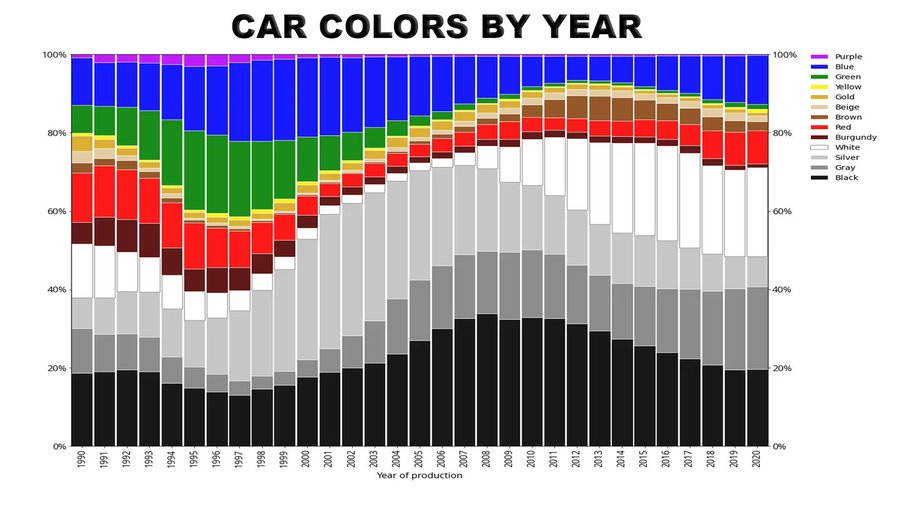
The world is becoming less colorful. I’d been vaguely aware of this as a trend in Europe and the US, but I’m surprised how gelobal it is.
Remember the common grumble about the DDR being how drabw it was? I wouldn’t be surpised if unified Germany is now back to the East German color palette.

Cars become monochrome

Some past color changes have been triggered by technology. Synthetic dyes made color less of a luxury, starting with the Prussian Blue that let allowed Frederick the Great to kit out an entire army in blue uniforms

Himself, too

As an aside: one bonkers-but-brilliant theory is that Caravaggio’s chiaroscuro painting style, with a massive contrast between bright and dark areas, was a way to save money on dyes. He could use the good stuff only for the highlighted areas, and had artistic justification to use cheaper, duller colors for the rest.

Just a little lapis lazuli

just a little lapis lazuli

Neon signage exploded in usage in the 1920s and -30s, immediately after being invented – but once it was no longer new it became declasse.

And yet…we are living through at least a minor transformation in the economics of lighting. I’m talking about LEDs. Not only has the price cratered, but they bring different color options compared to incandescent bulbs. But I suppose the difference isn’t enough for us to become more colorful.

price of LEDs keeps dropping

Snippets

Sentences I have enjoyed:

It’s a universal axiom that when an art style is practiced outside the center where it was developed and perfected, its most obvious features tend to be overemphasized.
– From a New York Times artice on the Bloomsbury Group

sleep apnea…is a disease of modernity (jaw sizes have shrunk and tongue sizes have grown
– from a comment on Astral Codex Ten

People are very good at maintaining a set of beliefs that allow them to not feel guilty, and the easiest way to do this is to believe that anything you think you should do but don’t want to is impossible.
– from DRMacIver’s notebook

Some Links

A valient attempt to find something not to hate in the Daily Mail:

But its worldview is more nuanced than its opponents believe. Unlike other Right-wing papers, it opposed the Iraq War. It regularly campaigns on civil liberties issues or the environment; Dacre, a true conservative, took a huge dislike to ubiquity of plastic bag litter. It dislikes open-door immigration and people taking advantage of the system but it has often spoken up for individual immigrants who are mistreated. It has a strong idea of fairness and decency, one reason it campaigned for Stephen Lawrence’s family.

Foucault as a tool for right-wing politics. The slave’s tools will rebuild the master’s house!

If Foucault’s thought offers a radical critique of all forms of power and administrative control, then as the cultural left becomes more powerful and the cultural right more marginal, the left will have less use for his theories, and the right may find them more insightful.

[Language Log] on compound words with ass, digs out a paper on the topic:

Although the origin of the ‘-ass’ suffix is unclear, it would seem to have spread from a more restricted nominalizing morpheme, which attaches not only to adjectives, but also to verbs: bad-ass (‘Check the dude in the leather jacket – he’s a total bad-ass!’), hard-ass, slack-ass, whup-ass (‘If you don’t shut up, I’m gonna open up a big can of Texas-style whup-ass on ya.’), lazy-ass, stupid-ass and kiss-ass, for example. Note that many of these can also be used as emphatic adjectives (stupid-ass, lazy-ass, slack-ass, hard-ass).

Some Links

A valient attempt to find something not to hate in the Daily Mail:

But its worldview is more nuanced than its opponents believe. Unlike other Right-wing papers, it opposed the Iraq War. It regularly campaigns on civil liberties issues or the environment; Dacre, a true conservative, took a huge dislike to ubiquity of plastic bag litter. It dislikes open-door immigration and people taking advantage of the system but it has often spoken up for individual immigrants who are mistreated. It has a strong idea of fairness and decency, one reason it campaigned for Stephen Lawrence’s family.

Foucault as a tool for right-wing politics. The slave’s tools will rebuild the master’s house!

If Foucault’s thought offers a radical critique of all forms of power and administrative control, then as the cultural left becomes more powerful and the cultural right more marginal, the left will have less use for his theories, and the right may find them more insightful.

[Language Log] on compound words with ass, digs out a paper on the topic:

Although the origin of the ‘-ass’ suffix is unclear, it would seem to have spread from a more restricted nominalizing morpheme, which attaches not only to adjectives, but also to verbs: bad-ass (‘Check the dude in the leather jacket – he’s a total bad-ass!’), hard-ass, slack-ass, whup-ass (‘If you don’t shut up, I’m gonna open up a big can of Texas-style whup-ass on ya.’), lazy-ass, stupid-ass and kiss-ass, for example. Note that many of these can also be used as emphatic adjectives (stupid-ass, lazy-ass, slack-ass, hard-ass).

Snippets

Sentences I have enjoyed:

It’s a universal axiom that when an art style is practiced outside the center where it was developed and perfected, its most obvious features tend to be overemphasized.
– From a New York Times artice on the Bloomsbury Group

sleep apnea…is a disease of modernity (jaw sizes have shrunk and tongue sizes have grown
– from a comment on Astral Codex Ten

People are very good at maintaining a set of beliefs that allow them to not feel guilty, and the easiest way to do this is to believe that anything you think you should do but don’t want to is impossible.
– from DRMacIver’s notebook

Julia Serano on appropriation

Almost a decade ago, Julia Serano wrote a wonderful essay on appropriation. I keep on coming back to it, because it clarifies a debate which recurs again and again in activist contexts. In particular, she captures some of the discomfort I felt in the early 2000s, as allegations of appropriation became a big deal in my social and political circles. The picture is very real, even though she is writing more narrowly about trans activism:

trans activists often encouraged forms of gender transgression in the cisgender majority, as it was generally believed that such expressions would help undermine binary gender norms throughout society.

And suddenly now in 2013, some trans people are essentially taking the exact opposite approach by discouraging cisgender people from transgressing gender norms (via accusations that such actions represent an appropriation of transgender identities and culture).

Critique of cultural appropriation, which is what I mainly encountered, was definitely in part a needed correction to some existing attitudes. But there were (and continue to be) times when that critique seemed to preclude any interaction, and send everybody back to their own parochial background.

Serano starts by identifying the most clearly bad forms of appropriation, in a satisfyingly clear-cut way. Appropriation is bad when it is used to Exclude, Exploit or Denigrate the target group.

Beyond that, opinions differ. Serano now situates the debate about appropriation in the context of wider political movements, on two axes. The first is stigma. When a group is heavily stigmatised, then it is a brave and costly signal for an outsider to adopt their markers. Therefore the insiders are more likely to appreciate this as a gesture of support and solidarity. If the stigma decreases, it becomes possible to adopt the markers of a group without much personal cost, and doing so can look like ‘tourism’. The outsider takes advantage of the culture of the group, without having risked or contributed anything.

The second axis differentiates activists aiming at separation, from those aiming at integration into mainstream society. Discouraging appropriation helps to maintain a clear boundary between you and the mainstream, which can be very appealing. But if your endgame is to be accepted within society, you would prefer to welcome others to adopt aspects of your identity.

I would add another angle, which Serano gestures to but underemphasises. That is, whether you see group membership as innate or chosen. If you believe that people can join and leave your group, then you almost need to accept those who are in a transitional stage. I’m very much of the attitude that most identities can be chosen. But even I have to accept that some are unavailable, perhaps because they are in the past, e.g. a certain kind of upbringing.
Julia Serano on appropriation

Almost a decade ago, Julia Serano wrote a wonderful essay on appropriation. I keep on coming back to it, because it clarifies a debate which recurs again and again in activist contexts. In particular, she captures some of the discomfort I felt in the early 2000s, as allegations of appropriation became a big deal in my social and political circles. The picture is very real, even though she is writing more narrowly about trans activism:

trans activists often encouraged forms of gender transgression in the cisgender majority, as it was generally believed that such expressions would help undermine binary gender norms throughout society.

And suddenly now in 2013, some trans people are essentially taking the exact opposite approach by discouraging cisgender people from transgressing gender norms (via accusations that such actions represent an appropriation of transgender identities and culture).

Critique of cultural appropriation, which is what I mainly encountered, was definitely in part a needed correction to some existing attitudes. But there were (and continue to be) times when that critique seemed to preclude any interaction, and send everybody back to their own parochial background.

Serano starts by identifying the most clearly bad forms of appropriation, in a satisfyingly clear-cut way. Appropriation is bad when it is used to Exclude, Exploit or Denigrate the target group.

Beyond that, opinions differ. Serano now situates the debate about appropriation in the context of wider political movements, on two axes. The first is stigma. When a group is heavily stigmatised, then it is a brave and costly signal for an outsider to adopt their markers. Therefore the insiders are more likely to appreciate this as a gesture of support and solidarity. If the stigma decreases, it becomes possible to adopt the markers of a group without much personal cost, and doing so can look like ‘tourism’. The outsider takes advantage of the culture of the group, without having risked or contributed anything.

The second axis differentiates activists aiming at separation, from those aiming at integration into mainstream society. Discouraging appropriation helps to maintain a clear boundary between you and the mainstream, which can be very appealing. But if your endgame is to be accepted within society, you would prefer to welcome others to adopt aspects of your identity.

I would add another angle, which Serano gestures to but underemphasises. That is, whether you see group membership as innate or chosen. If you believe that people can join and leave your group, then you almost need to accept those who are in a transitional stage. I’m very much of the attitude that most identities can be chosen. But even I have to accept that some are unavailable, perhaps because they are in the past, e.g. a certain kind of upbringing.

History of American Socialisms

In the 1840s, a wave of intentional communities spread across America. Most of them collapsed within a year or two, as has been the story of most attempts at communal living in any context.

One of the longest-lasting was Oneida. It was based around the principles of Free Love and Mutual Criticism, and its inhabitants spend their days making knives. The founder, John Humphrey Noyes, had apparently taken some care in finding the right system.

In the process he wrote a book, a history of American socialisms. Based in part on a survey of communes, it was his attempt to figure out what system might lead a community to survive:

This country has been from the beginning, and especially for the last forty years, a laboratory in which Socialisms of all kinds have been experimenting. It may safely be assumed that Providence has presided over the operations, and has taken care to make them instructive. The disasters of Owenism and Fourierism have not been in vain ; the successes of the Shakers and Rappites have not been set before us for nothing. We may hope to learn something from every experiment.

History of American Socialisms

In the 1840s, a wave of intentional communities spread across America. Most of them collapsed within a year or two, as has been the story of most attempts at communal living in any context.

One of the longest-lasting was Oneida. It was based around the principles of Free Love and Mutual Criticism, and its inhabitants spend their days making knives. The founder, John Humphrey Noyes, had apparently taken some care in finding the right system.

In the process he wrote a book, a history of American socialisms. Based in part on a survey of communes, it was his attempt to figure out what system might lead a community to survive:

This country has been from the beginning, and especially for the last forty years, a laboratory in which Socialisms of all kinds have been experimenting. It may safely be assumed that Providence has presided over the operations, and has taken care to make them instructive. The disasters of Owenism and Fourierism have not been in vain ; the successes of the Shakers and Rappites have not been set before us for nothing. We may hope to learn something from every experiment.

Basket-case Reduction

David MacIver writes good articles about psychology and coping with life, for example “How to do hard things”. Over in the world of computers, he is also an expert in something called test case reduction

The idea of test case reduction is to find the simplest thing that will break a program. You might, for example, start with a thousand-word essay that you can’t upload to a particular website. To understand what’s going wrong you remove text until you find the shortest input that breaks things – maybe the website can’t handle accented characters or something. You can do this by hand, or if you’re smart you will use some of David’s code to do it automatically.

David has heroically resisted the temptation to phrase self-help in terms of debugging. In his position I would have given in immediately – because so many of the processes I go through to figure out my head are equivalent to debugging.

I have the benefit that my brain is pretty good at running simulations of how I would behave in different situations. So when a situation freaks me out, I can later apply my own internal test case reduction. ‘Would I have coped better if I had trusted the other person?’ I might ask myself. “What about if I felt confident in my knowledge of what we were talking about?” And if it works, I’ll eventually have a simplified scenario which showcases the bug in my brain.